On a stretch of County Road P about seven miles east of Viroqua, Wisconsin, a former civil engineer named Sarah Holst-Larsen has been homeschooling her two sons for four years. They live in a two-story farmhouse built in 1907, on six acres bordered by an Amish neighbor's hayfield.
Her sons are Henrik, eleven, and Soren, eight. The school day, when there is a school day, begins at 9:00 in the kitchen and tends to wind down by 1:00, after which the boys do chores, read, or disappear outside.
Holst-Larsen did not begin as a homeschooler by conviction. She and her husband, Pete, pulled Henrik out of the local public elementary in 2022 after a year of escalating anxiety and a reading score that, despite his obvious facility with chapter books at home, would not move.
"He could read," she says. "He could read all the time. He just couldn't read on Tuesday at 10:15 when they asked him to."
They told themselves they would try one year. They are now in their fourth.
The Holst-Larsen family is part of a small but growing community of homeschoolers in the Driftless Area of southwestern Wisconsin. The region has long held a particular concentration of Amish, Mennonite, and Anabaptist families, and in the last decade has drawn a second wave of secular homeschoolers, many from larger cities to the east.
Wisconsin's homeschool regulations are, by national standards, light. Families file a single form each year, the PI-1206, attesting that they will provide instruction in the required subjects for at least 875 hours. There is no curriculum review and no testing.
Holst-Larsen keeps her own records anyway. She has a hardbound notebook for each child for each year, in which she logs, in pencil, what was done each day.
On a Tuesday morning in early May, she opens the notebook at the kitchen table. The boys are still eating oatmeal. Henrik is reading a book about the Erie Canal. Soren is, by his own report, thinking.
The morning's plan, which Holst-Larsen sketches on the back of a grocery list, runs as follows: thirty minutes of math, forty minutes of reading aloud (she reads, both boys listen), an hour of project work, and then whatever the boys want to do.
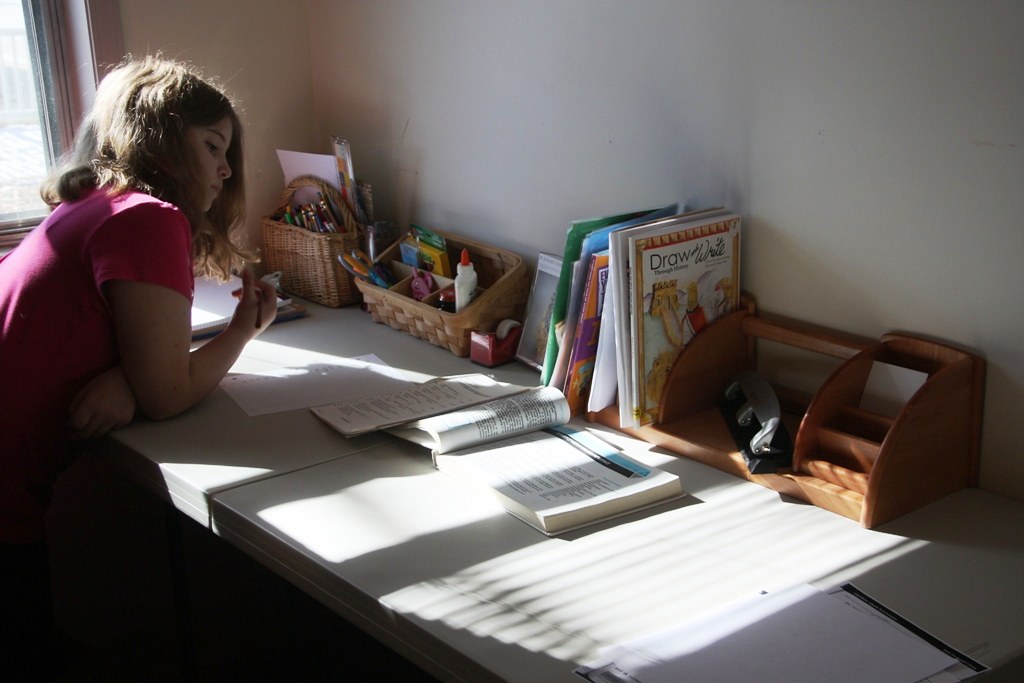
Math today is fractions for Henrik and place value for Soren. They work at opposite ends of the kitchen table while their mother washes the breakfast dishes. She comes over when called.
She uses a curriculum called Math With Confidence for Soren and Beast Academy for Henrik. She has tried, over the years, six different math curricula. "You don't know which one will fit until you try," she says, "and you don't know it has stopped fitting until it stops fitting."
The read-aloud is currently The Birchbark House by Louise Erdrich. They are about halfway through. Both boys listen with the slightly glazed attention that read-alouds produce. Soren is whittling a small stick into a sharper small stick with a pocketknife as he listens.
The project work is the part of the day Holst-Larsen has come to value most. The boys each choose, every two weeks, a thing to learn about. They make a plan with her. They do the work mostly on their own. At the end they present what they made to her and to their father at dinner.
Henrik is currently studying the Erie Canal. He has built, in the basement, a six-foot model out of scrap lumber and is working out how to make a functioning lock from a plastic storage bin.
Soren is studying birds of prey. He has, on the kitchen wall, a hand-drawn chart of the seven species he has identified in their woods. The chart is misspelled in three places. Holst-Larsen has not corrected it.
Lunch is at noon. The boys make their own sandwiches. Henrik makes one for his mother as well, with too much mustard, which she eats without commenting on the mustard.
After lunch, on most days, Holst-Larsen says school is over. Today the boys go outside. They are building, at the edge of the field, a structure they call the fort. It has been under construction since October.
The Driftless Folk School, in nearby Westby, offers monthly classes for homeschooled children — blacksmithing, baking, basketry. Henrik and Soren go to the blacksmithing class, which meets the first Saturday of the month.
Once a week the family meets with a homeschool co-op of about eleven children at a small Lutheran church in Viroqua. The co-op rotates parents teaching: art one week, Spanish another, a long unit on early American history this spring.
Holst-Larsen does not think homeschooling is for everyone. She does not think it is, in any straightforward sense, better than school. She thinks it has, for her two children at this stage of their lives, been the right thing, and that she will know if and when it is not anymore.
"The thing about homeschooling," she says, "is that the curriculum is your family. Your family is the curriculum. You cannot get away from it. Some days that is wonderful. Some days you would give anything for a yellow bus to come up the driveway at 7:45."
At 4:30 the boys come in with mud on their pants and a pheasant feather Soren found in the field. He puts it in a coffee can on the windowsill, where the feathers go.